1)
Short
Answer Questions
Here's
a quick list of terms that you will need to know for the test. I have also give
you the links for the essay questions.
Classical
era, fertility figure, Kouros, Cuniform, Ukiyo-E, Nok, mosaic, illuminated
manuscript. Chartres Cathedral,
Gothic
era, Renaissance era,Neoclassical era, Baroque era,
2) (Question 1 - Part 1) Caravaggio http://www.wga.hu/frames-e.html?/html/c/caravagg/06/35emmau.html Delacroix s Liberty Leading the People http://www.wga.hu/frames-e.html?/html/d/delacroi/2/208delac.html Caravaggio is a Baroque artist and Delacroix is a Romantic
artist. Describe what is happening in each painting. Compare these two
paintings and show how each painting shows the typical characteristics of art
of its time period. How can we tell that they were painted during different
time frames. Answer fully - about 7 to 8 paragraphs.
3)

We
are covering the version of Supper at Emmaus that is in London -
Supper at Emmaus
1601
Oil on canvas, 141 x 196 cm
National Gallery, London
Oil on canvas, 141 x 196 cm
National Gallery, London

Liberty Leading the
People (28th July 1830)
1830
Oil on canvas, 260 x 325 cm
Musee du Louvre, Paris
Oil on canvas, 260 x 325 cm
Musee du Louvre, Paris
Here's
a couple of weblinks for more background about Dalacroix and his painting
"Liberty Leading the People".
http://en.wikipedia.org/wiki/Liberty_Leading_the_People
Essay Two – Jacques Louis David
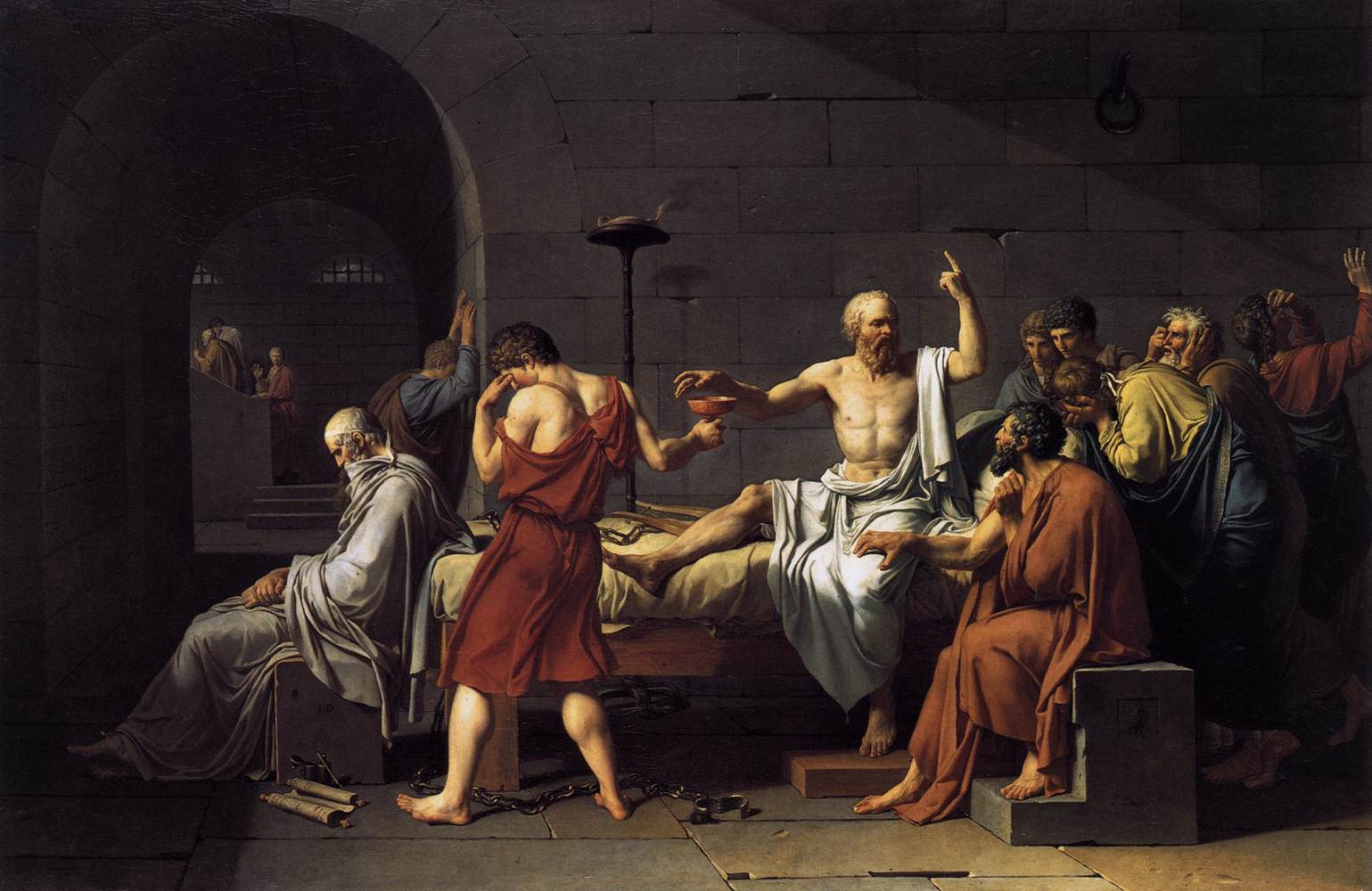
What characteristics of Neoclassical artwork are seen in David's "Death of Socrates?" Describe what is happening in the painting. Name features and things seen in the painting that provide evidence of its being the work of a Neo-Classical painter. Answer fully, you want at least 7-8 paragraphs for an answer.
What characteristics of Neoclassical artwork are seen in David's "Death of Socrates?" Describe what is happening in the painting. Name features and things seen in the painting that provide evidence of its being the work of a Neo-Classical painter. Answer fully, you want at least 7-8 paragraphs for an answer.

The Death of Socrates
For a larger image, please try http://www.wga.hu/art/d/david_j/2/205david.jpg
This will enable you to see more of the
details in the painting.
Several of the persons shown played
roles in many of Plato’s Dialogues. The dialogue “Phaedo” was the one in which
Socrates famously drank the hemlock poison. Below are some of the persons
believed to have been portrayed.

In the image below, you may be able
to see a little more because the picture has been electronically brightened.